
- Working Hour: 09.00am - 05.00pm
- Email: sales@sohanscientific.in
- Email: jankee@sohanscientific.in
Spectrometers: Devices and Mechanism
Spectrophotometry is a measurement of how much a chemical substance absorbs or transmits light (electromagnetic radiation) over a range of wavelengths. It's widely used in chemistry, biology, and clinical applications for **quantitative analysis**.
Basic Structure of Spectrometers

Figure 1: Basic components—Light Source, Collimator, Monochromator, Wavelength Selector, Sample Solution, and Detector.
Key Components & Function
Spectrometers:
Consists of two devices: a **spectrometer** and a **photometer**. It measures the intensity of light detected after it passes through a sample solution.
1.
Spectrometer (Monochromator):
Produces a **desired range of wavelengths**. A collimator first transmits a straight beam of light which then passes through a **monochromator** (prism/grating) to split it. A slit then selects only the required wavelengths.
2.
Photometer (Detector):
Detects the amount of photons that are **absorbed** or **transmitted** by the sample solution in the cuvette, sending a signal to a digital display or meter.
Key Variations:
The technique is broadly classified by its light source: UV-visible spectrophotometer (185 – 700 nm) and IR spectrophotometer (700 – 15000 nm).
Our Scientific Products

DS-36D Benchtop Spectrophotometer
Dual Optical Path, Automatic Calibration Technology for superior accuracy in color measurement.

Portable Spectrophotometer
Compact and robust for on-site color analysis. Ideal for field measurements and quality control.
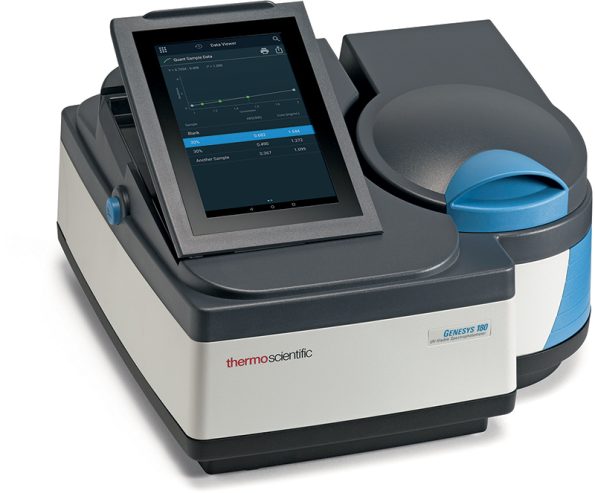
Almighty Spectrophotometer
Versatile capabilities for a wide range of spectral analysis, delivering comprehensive data.