
- Working Hour: 09.00am - 05.00pm
- Email: sales@sohanscientific.in
- Email: jankee@sohanscientific.in
Spectrophotometry: Principles, Devices, and Mechanism
Spectrophotometry is the precise measurement of **light absorption or transmission** by a substance across a spectrum of wavelengths, forming the basis of quantitative and qualitative analysis in science and industry.
Basic Structure of Spectrophotometers

Figure 1: Components include Light Source, Monochromator, Sample Cell (Cuvette), and Detector.
Component Breakdown
Light Source
Provides a steady beam of light (e.g., Deuterium lamp for UV, Tungsten lamp for Visible, or LED arrays).
Monochromator
Uses a prism or diffraction grating and a narrow slit to isolate a **single, specific wavelength** of light.
Sample Cell (Cuvette)
Holds the sample solution. The path length (usually $1$ cm) is crucial for the measurement equation.
Detector & Readout
Measures the intensity of light that successfully passes through the sample, converting it into a digital signal (Absorbance or Transmittance).
The Beer-Lambert Law
The fundamental principle governing spectrophotometry is the Beer-Lambert Law, which states that the amount of light absorbed by a solution is **directly proportional** to the **concentration** of the absorbing substance and the **path length** of the light through the solution.
$A = \epsilon \cdot c \cdot l$
where: $\mathbf{A}$ = Absorbance | $\mathbf{\epsilon}$ = Molar Absorptivity | $\mathbf{c}$ = Concentration | $\mathbf{l}$ = Path Length
Common Spectrophotometer Variations
UV-visible (185 – 700 nm)
Infrared (IR) (700 – 15000 nm)
Atomic Absorption (AAS)
Portable/Handheld Units
Our Scientific Products

DS-36D Benchtop Spectrophotometer
Dual Optical Path, Automatic Calibration Technology for superior accuracy in color measurement.

Portable Spectrophotometer
Compact and robust for on-site color analysis. Ideal for field measurements and quality control.
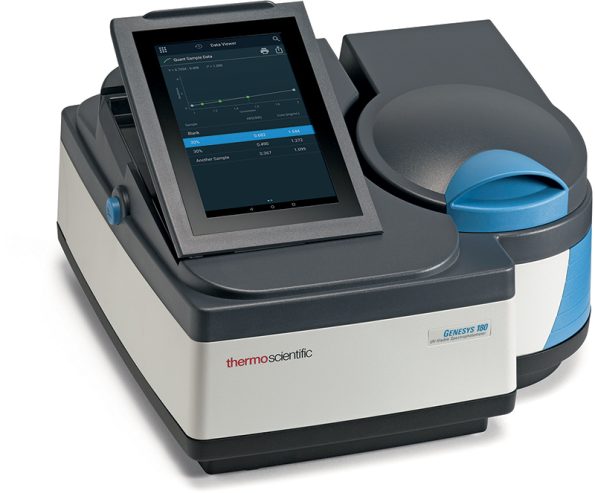
Almighty Spectrophotometer
Versatile capabilities for a wide range of spectral analysis, delivering comprehensive data.